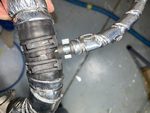
Consideration of gascolator installation
I considered the idea of omitting the fuel filters between the wings and the fuel switch and instead install a gascolator firewall forward just ahead of the electrical fuel pump. The reason for this was the perceived difficulty in doing a 12-monthly/100hour replacement of the fuel filters which were envisaged to be mounted inside the centre console.
There are admitted issues with a gascolator at this location. While the filtering function is good, the location as shown below mounted in front of the firewall places it only in a local minimum height in the fuel system. The fuel lines rise up from the wings (where there are drains installed) pass though the fuel switch and then further up to pass through the firewall. The fuel line then drops down to the gascolator. The most likely point of entry for water into the fuel system will be via the wing refuelling caps or from condensation on the roof of the wing tanks. This water will be drained when the wing tanks are drained. It is most unlikely that any of this water could ever get past the rise in the fuel lines to be subsequently caught in the gascolator. Communication with Sling 2 owners using the gascolator suggests none have ever drained water from it. Any water that might be caught in the low point ahead of the firewall in the area of the fuel pump would be rapidly swept up and eliminated from the fuel system during runups, given the flow rates of 15L/hour or 4.2 mL/sec. In 5/16" (8mm) ID hose this corresponds to a flow velocity of 83mm/sec.
(Dec 2025) I subsequently installed the fuel filters between the wings and the fuel switch at a more accessible and serviceable location. This - and the considerations above - lead to a decision to not install this gascolator. The final fuel design also includes a single additional fuel filter after the mechanical fuel pump. The fuel filters eventually used are of aluminium billet construction, with 70um mesh, and are openable and cleanable.
Author


This post is from Adam Dickson