Decision whether to use SV-AP-TRIMAMP or not
There is a lot of confusing, ambiguous, and just plain contradictory information about the functionality of the SV-AV-TRIMAMP on the Dynon website. There is also some confusion out in the forums. This confusion is reflected in AI responses to questions about the unit.
1) The installation manual states
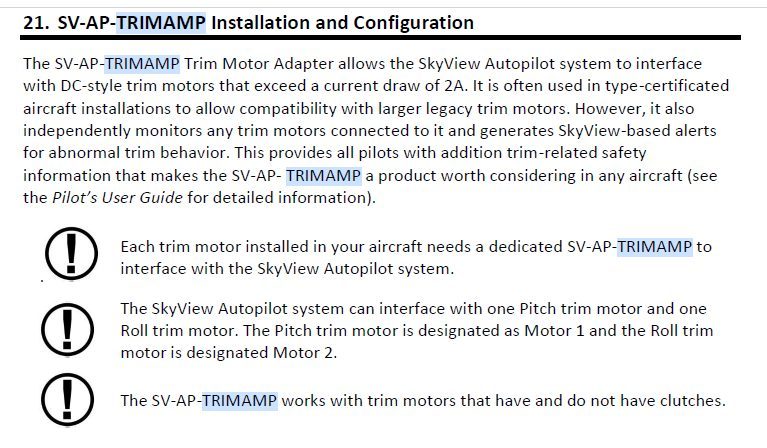
2) The Dynon product webpage states
SkyView Trim Motor Adapter – Dynon Avionics
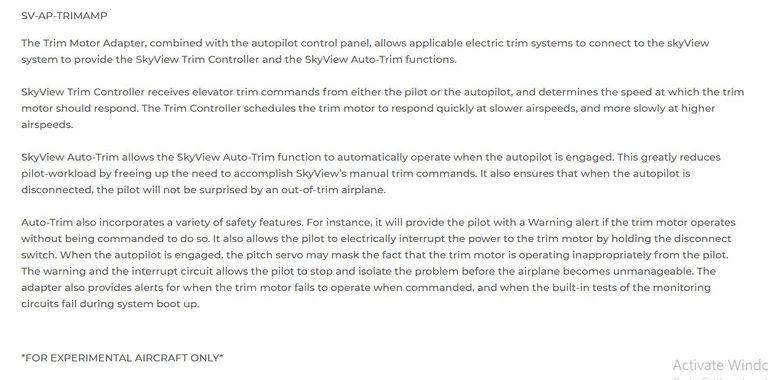
which gives the very distinct impression that the TRIMAMP is required in order to use auto-trim, as well as speed dependent trim rate control
3) The Dynon certified product webpage states
Dynon Certified | SkyView Trim Motor Adapter
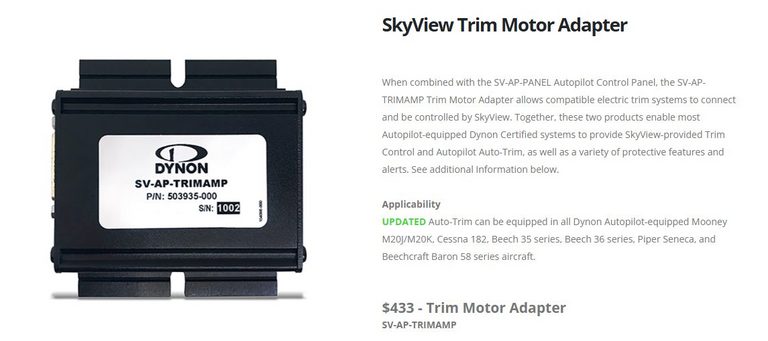
as well as
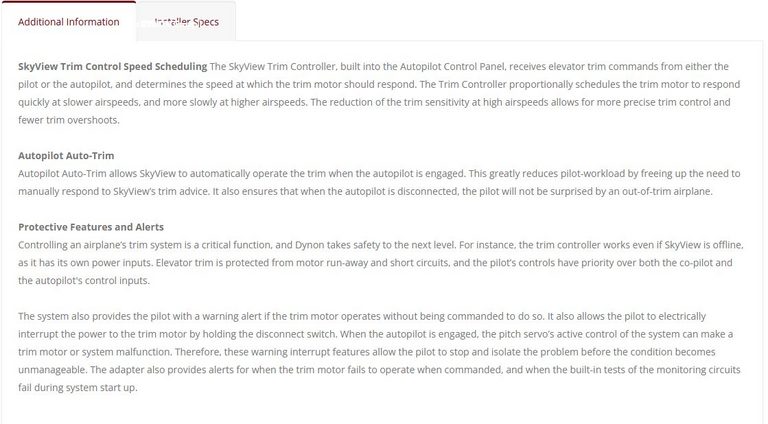
The impression already gained is reinforced by these documents.
On this basis I purchased the SV-SP-TRIMAMP
Communication with Dynon support (always excellent, with immediate reponses) has confirmed this impression is false.
The autotrim and speed-dependent trim rate control is fully implemented in a system with just the SV-AP-PANEL, connected to the HDX. It has been confirmed that the TRIMAMP is just a buffer as the name suggests needed to power the higher current (>2A) trim motors in legacy and certified aircraft. Since I am using the Ray Allen T2-7A trim controller (<2A) there is no need for the TRIMAMP.
Much of the material in the web pages is simply information about the trim system as a whole, and not something which the TRIMAMP forms a necessary component. The exception appears to be the following functionality:

The TRIMAMP has interrupt and activity lines
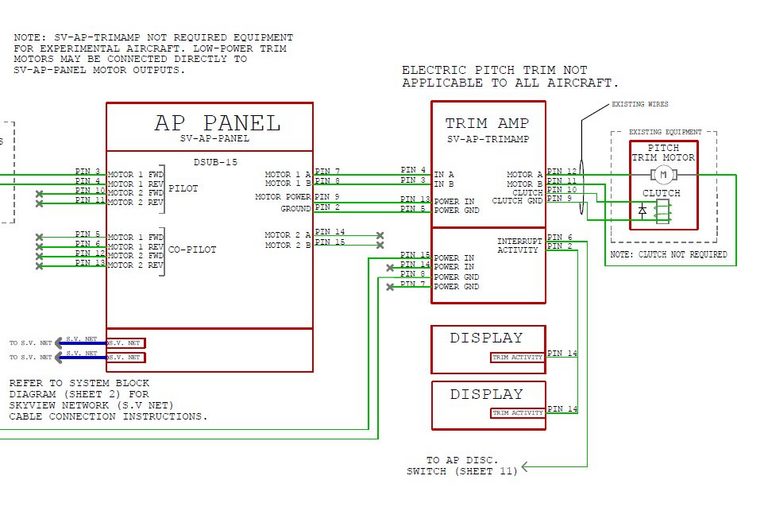
to facilitate this additional control and monitoring. There is a layer of additional safety provided by the TRIMAMP. I will assess the merit of this by further enquiry with Dynon. On this information I will consider whether or not I attempt a return of this unit, which is still boxed
The main offender is reference 2). The installation manual 1) is fine. Reference 3) is actually fine.
The Pilots User Manual has the following, in Section 2
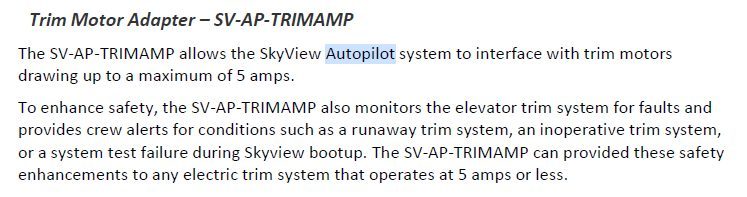
and in Section 12

These trim runaway or failure modes is clearly associated with the activity signal. The presence of the signal when no drive is intended is clearly an indication of trim runaway. The absence of this signal is an indication of trim failure. I am checking this with Dynon, but if correct I am attracted to this additional level of safety.
I have flown a Sling 2 aircraft and had a trim CB pop on early final. I only noticed something was up when I found I could not get the aircraft on landing trim. I then noticed the CB. It would be nice to get a visual warning on the EFIS.
28 March 2026:
I have checked with Dynon support. They have warned that the RC-Allen T2-7A trim motor current is so low that it might not register as "activity" - the threshold for this is set at a level appropriate for higher current legacy trim motors. I would be likely to get repeated "trim stuck" warnings despite correct activity of the trim motor. So the remaining safety advantage of the trimamp is lost, so accordingly I have decided to return it.
Another builder has suggested adding a resistor in parallel with the trim motor to boost its apparent current draw into the range of legacy trim motors. This is possibly a good idea, but a reliable implementation would require greater knowledge of the signal put out by the trimamp. For example is the variable drive rate of the motor achieved via a variable PWM duty ratio, or via a variable low-pass filtered DC-like signal. In the former case it would be a simple matter to select a suitable resistor, but in the latter case a suitable choice could be problematic. In addition, the exact level of threshold for activity detection is not specified.
Author

This post is from Adam Dickson