Compromise on rethink of IBBS usage and backup approach
Referring to
there is a middle ground.
The current draw of the main EFIS is 2.96A and 3.96A when charging. The presence of the SV-BAT-320 is perhaps a little redundant and is the Li-ion type which is less thermally stable than the LiFePO4 type of the IBBS. Perhaps the former can be dispensed with at some point in the future.
The total current draw of the avionics (when transmitting) is 3.5A
The total current is 6.46A or 7.46A when the SV-BAT-320 is charging. This happens to fall under the 8A continuous limit of the IBBS.
These numbers are taken from
https://webuildplanes.com/adam-dickson-sling2/p/7175/review-of-master-and-alternator-bus-breakers
Meanwhile, reintroduce an essentials bus, on which the EFIS (with an on-off switch) resides and also the avionics bus (with an on-off switch) also resides.
The backup/main switch can remain to the left of the master switch, keeping the manual control. The avionics and EFIS switches retain their function.
I could add a function to the backup switch to disconnect the SV-BAT-320 to reduce the maximum current draw to 6.46A, but given the maximum when charging is 7.46A, still under the 8A limit I will not bother.
The option of eliminating the SV-BAT-320 exists in the future.
Note that the CHG OUT CB can be eliminated.
Instead, a ESS BUS CB to protect the MS35058 backup/main switch from the 30A CB protected main bus as noted in a previous post
https://webuildplanes.com/adam-dickson-sling2/p/7331/fix-defect-in-cb-design-of-backup-switch
This breaker can be rated the same as the fuse at the output of the IBBS, namely 10A
So the list of breakers on the main bus is
- BK CHG - IBBS charge input
- REG - regulator
- TAXI LT - taxi lights
- LDG LT - landing lights
- AP - autopilot servos
- NAV LT - navigation lights
- STROBE - strobe lights
- FLAPS - flaps
- TRIM - trim
- BOOST - boost pump
- CAB LT - cabin light
- ESS BUS - essential bus breaker
- START - start solenoid
- USB - usb power
Note there is no longer a CHG OUT CB in the main cluster
The reintroduced essentials bus has
- a SPST switch which powers the avionics bus
- a SPST switch which powers the main EFIS via a 5A CB
The list of CBs on the avionics bus remains as
- COM - com radio
- IC - intercom
- XPNDR - transponder/ads-b in
- FLARM- flarm
- BK EFIS - backup efis
- HDST -headset
Note that both the CHG OUT and a separate AVNCS CB is eliminated
There are a total of 21 2TC2 type breakers - one above the number of available positions. The spillover will be taken by the USB which will be moved to the right of the panel
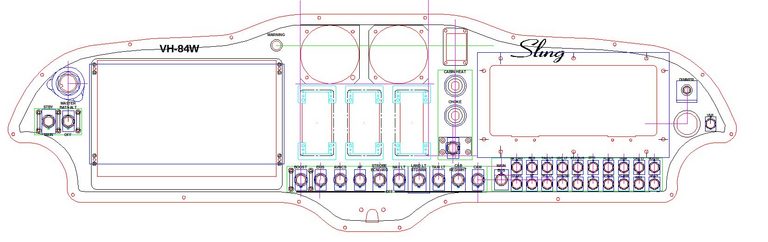
Happily the START and REG CBs can be moved back into the main cluster of breakers
A possible rearrangement of the CBs is as follows
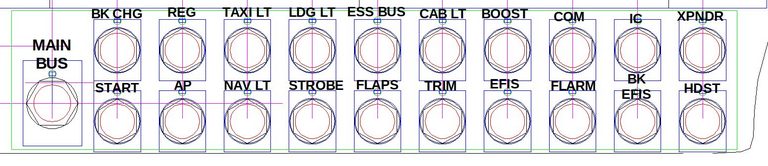
which clusters the avionics bus to the right. The BOOST CB should be moved to the top left also.
The schematic for the concept is
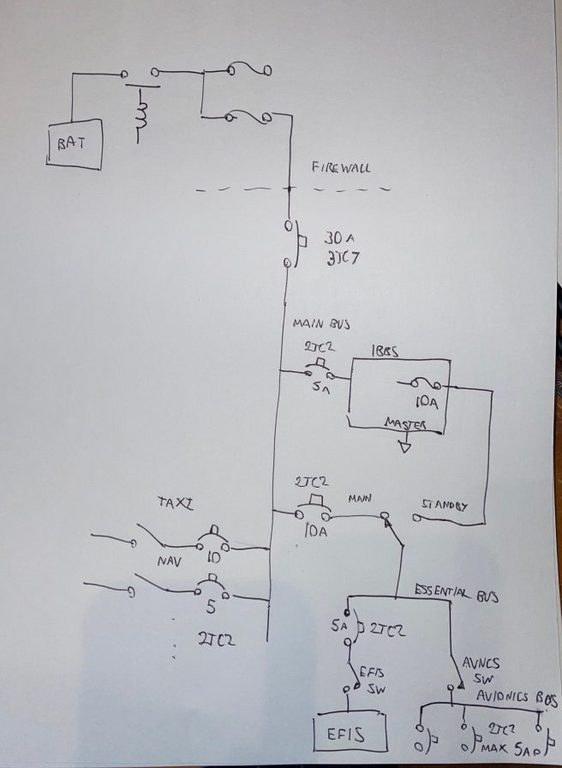
where the EFIS CB and switch can be swapped if convenient, although the position shown is preferable as a short downstream of the EFIS CB will (probably) not blow the IBBS fuse if running on standby power
This differs from
https://webuildplanes.com/adam-dickson-sling2/p/7229/firewall-forward-power-feed-and-backup-electrical-system-concept
in several respects:
- The 10A CB is added between the main bus and the main/standby switch, to protect the switch
- The 10A CB at the output of the IBBS is eliminated, as the total maximum load of the EFIS and avionics is less than 8A under normal operating conditions due to dumping ideas of incorporating flapsd, trim, etc
- Notions of uprating the fuse in the IBBS have been set aside
- Note that the original scheme also intended to include EFIS and avionics switches
I did consider the idea of moving the EFIS system onto the main bus, but this would have resulted in the collapse of the main/standby and avionics switch functions into a single switch, leaving an opening in the panel, the need to purchase a progressive type switch to maintain the aesthetics, all to no particular advantage. This approach is a good compromise.
Author

This post is from Adam Dickson