Re-examination of some alternative backup schemes and impact on panel
Following on from
suppose one did move the EFIS onto the main bus, so relying purely on its own backup battery. So the IBBS's role would just be to power the avionics bus. To match the EFIS backup battery's ability to power the EFIS for 60mins, given the avionics maximum current draw is 3.5A max, and only when transmitting, then surely there is no need for the 6AH battery, really only a 3AH battery.
Now also the backup/main switch and the avionics switch function can be rolled into on progressive type, which really should be in the main switch grouping. But this would leave an empty switch hole at the left of the panel. Note the number of required CBs is unchanged. The previous ESS BUS CB is replaced by a AVNCS CB performing the same function of protecting the progressive switch.
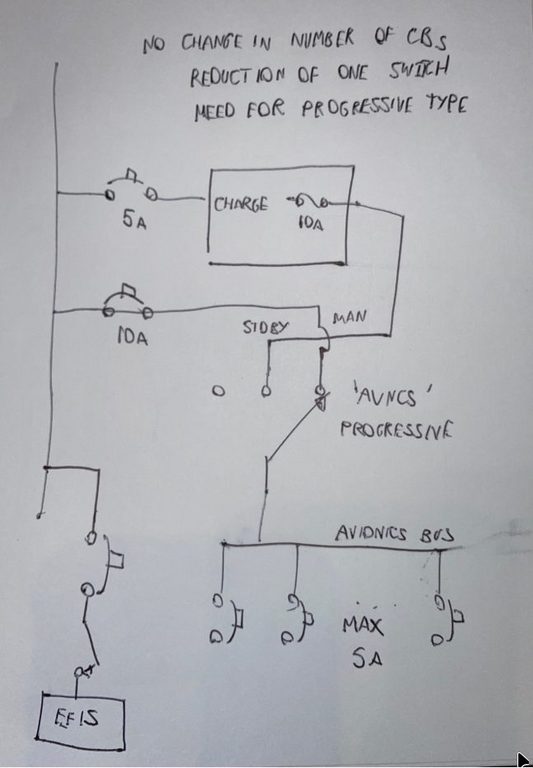
An alternative approach is to use the bypass function of the IBBS. This would also reduce the number of switches by one, but the remaining "avionics" switch would only need to be a SPST type. Note again the number of required CBs is unchanged, with the eliminated ESS BUS or AVNCS switch-protecting CB being replaced by the 10A CB required at the input of the IBBS.
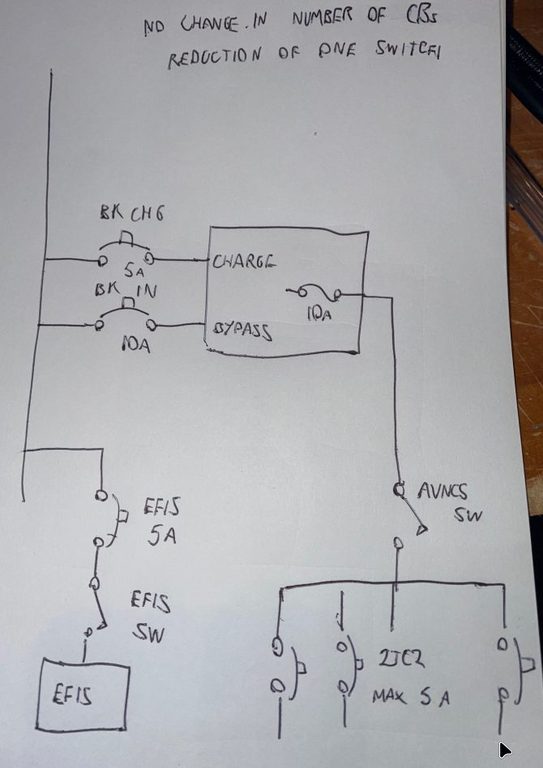
This issue with this scheme is of course the supply to the entire avionics stack is via the IBBS, with its non in-flight resettable fuse and the associated electronics of the IBBS itself.
Given both these alternatives create a empty switch position at the left of the panel, while otherwise providing no particular advantage or flexibility other than being slightly conceptually simpler for a pilot, involving fewer in-flight choices in a power-out situation, is why I am staying with the scheme previously defined in the link at top.
If I were to do the panel again I would probably adopt the scheme at the top, if I was fully confident about the capacity of the SV-BAT-320 when aged and hot. With the scheme as defined in the link, I retain the option of extending the useful life of the EFIS and avionics well past 60mins, given the total capacity of the IBBS and SV-BAT-320 is 6+4.4 = 10.4 AH. There is no doubt a balanced strategy of balancing the usage of the SV-BAT-320 by turning the EFIS switch off (forcing it onto the SV-BAT-320) after some time interval following the loss of the main bus. I can also save avionics power capacity by pulling the FLARM power at some point, although this does not seem like such a great idea.
The idea of a balanced strategy is as follows. With all the avionics on, but ignoring occasional transmits, the power draw of the avionics is 1.5A, based on numbers in
https://webuildplanes.com/adam-dickson-sling2/p/7174/review-of-standby-bus-breaker-ratings
Similarly the draw of the EFIS is about 3A, when the SV-BAT-320 is not being charged. Assume at the moment of main bus failure the SV-BAT-320 is fully charged
So if the EFIS switch is on, the draw on the IBBS is 4.5A
So the charge in the IBBS after time T (in hours, from main bus failure) is 6-4.5T
Now at time Tsw the EFIS switch is turned off and it is forced onto the SV-BAT-320. Now given the assumption of being fully charged, it will still be fully charged
This battery is guaranteed to allow 1 hour of operation, which is quite a bit less then 4.4Ah/2.96A = 1.48 hours, so this 1 hour figure is clearly allowing for battery aging.
Using the 1 hour figure, the EFIS will then die at Tsw + 1 hours after main bus failure
The avionics will die Tsw + (6-4.5Tsw)/1.5 hours after main bus failure
Equating these two values gives Tsw = 1 hour
In the event of a main bus failure keep the EFIS switch "on" for about 1 hour, then turn it off. The EFIS will run for a further hour, and so will the avionics, for a total time of 2 hours. If one is going to transmit a lot, turn the EFIS switch off earlier.
This improvement of useful combined EFIS/avionics run time from 1 hour to 2 hours seems worthwhile
Alternatively, if the SV-BAT-320 is omitted entirely, one gets combined EFIS/avionics run time for 6/4.5 = 1 hour 20 mins after a main bus failure.
Author

This post is from Adam Dickson